- Published
- Last updated
- Publisher
- PTALK Editorial Team
Read the decision in one minute, then use the full article for the details and boundaries.
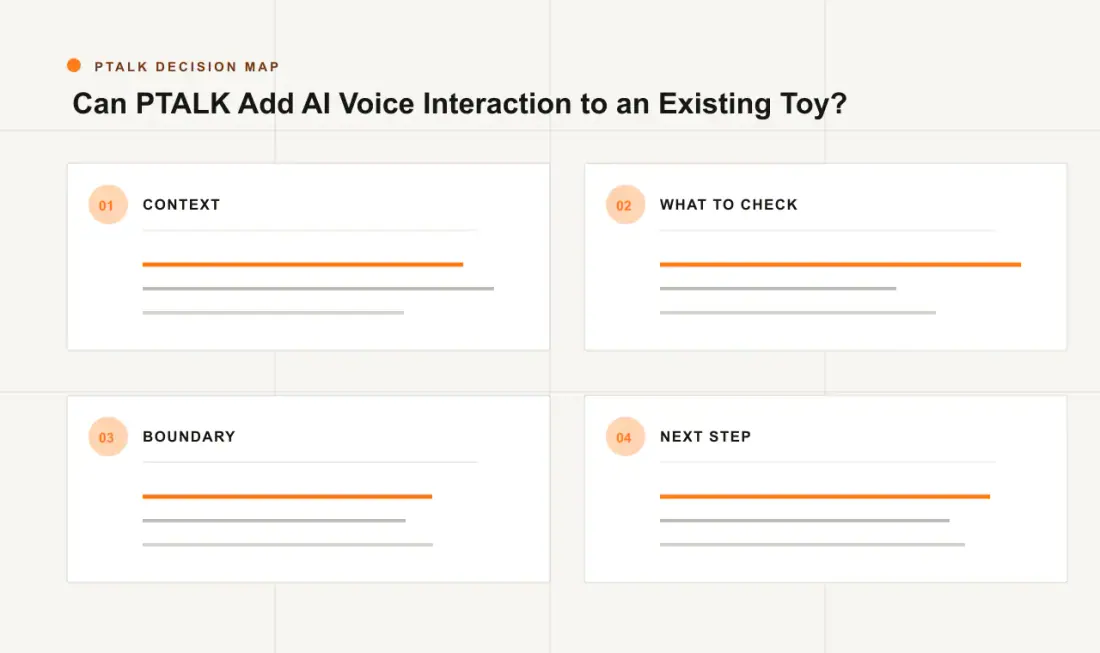
PTALK can evaluate whether an existing toy can add AI voice interaction by checking internal space, power, speaker, microphone, connectivity, cost target, and production modification difficulty.
Short answer
PTALK can evaluate whether an existing toy can add AI voice interaction by checking internal space, power, speaker, microphone, connectivity, cost target, and production modification difficulty.
Useful for early AI toy project screening, internal approval, vendor comparison, and delivery risk review.
For the AI toy decisions covered in this faq, PTALK can support product definition, smart hardware prototyping, agent platform configuration, knowledge base and persona content setup, AI mascot IP and tourism-content co-creation, content safety boundary design, device management and delivery review.
Start with the target user, device form, content scope, budget range, and launch timing, then move into prototype validation, backend configuration, pilot production, and production review.
Public pages explain capabilities, scenarios, cooperation paths, and specific evidence-backed credential or intellectual-property records. Pricing, lead time, other certifications, medical, privacy, copyright, and customer-data claims need project-specific confirmation.
Product configuration, scope, schedule, price, certification, and delivery responsibilities are confirmed against the actual brief.
Direct Answer
An existing toy can often be evaluated for AI voice interaction, but not every structure is suitable for direct retrofit. The project should first check space, power, audio, connectivity, cost, and appearance limits.
Best-Fit Scenarios
- Plush, figurine, movement, or electronic toys being upgraded
- Brands that want to preserve existing appearance and supply chain
- Channels testing the AI toy market with lower risk
PTALK Capability
- Hardware structure review, module selection, voice-chain setup, and character content configuration
- Prototype validation, BOM evaluation, production testing, and backend integration
- Private knowledge base and interaction boundary around the original IP
Delivery Steps
- Provide product dimensions, internal structure, power method, and board information
- Evaluate microphone, speaker, connectivity, and antenna space
- Choose light retrofit, board replacement, or new-version design
- Configure AI persona, content safety, and backend management
- Use prototype testing to decide production feasibility
Risk Boundaries
If the original toy has too little space, weak power capacity, or poor pickup conditions, redesign may be safer than retrofit. The final decision should be based on prototype testing.
Related Entry Points
AI Toy Solution, Smart Hardware Technology.
Business Next Step
If you already have a target audience, device form, or launch schedule, use Contact PTALK to submit the requirement. The team can continue with product definition, hardware prototyping, agent configuration, content safety, and production planning.