- Published
- Last updated
- Publisher
- PTALK Editorial Team
Read the decision in one minute, then use the full article for the details and boundaries.
An AI cultural tourism knowledge base should organize stories, routes, visitor questions, event information, and service rules with source tracking, update timing, and review workflow.
The practical takeaway
An AI cultural tourism knowledge base should organize stories, routes, visitor questions, event information, and service rules with source tracking, update timing, and review workflow.
Useful for teams studying AI cultural tourism product definition, hardware prototyping, agent platform setup, content safety, and production delivery.
For the AI cultural tourism decisions covered in this industry insights, PTALK can support product definition, smart hardware prototyping, agent platform configuration, knowledge base and persona content setup, AI mascot IP and tourism-content co-creation, content safety boundary design, device management and delivery review.
Start with the target user, device form, content scope, budget range, and launch timing, then move into prototype validation, backend configuration, pilot production, and production review.
Public pages explain capabilities, scenarios, cooperation paths, and specific evidence-backed credential or intellectual-property records. Pricing, lead time, other certifications, medical, privacy, copyright, and customer-data claims need project-specific confirmation.
Product configuration, scope, schedule, price, certification, and delivery responsibilities are confirmed against the actual brief.
Direct Answer
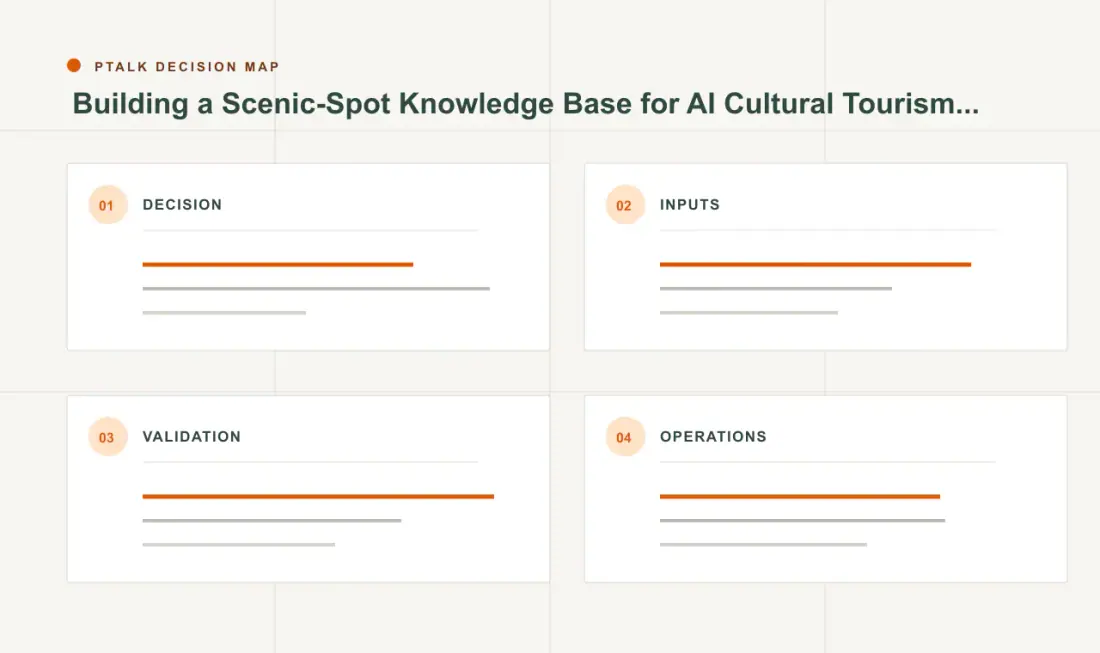
A scenic-spot knowledge base is not a pile of guide scripts. It should turn visitor questions, stories, routes, services, events, and commercial touchpoints into reviewable, searchable, and updateable content units.
Best-Fit Scenarios
- Scenic spots that want AI guide devices, interactive screens, cultural merchandise, or service robots to answer questions
- Cultural IP owners that need a unified story and character expression
- Operations teams that need fast seasonal updates
PTALK Capability
- Convert guide scripts, event files, and service rules into answerable content
- Configure guide personas, child-friendly versions, multilingual expressions, and recommendation scripts
- Support backend updates, content review, device groups, and point-specific distribution
Delivery Steps
- Map attractions, routes, services, events, and commercial points
- Mark content sources, update timing, and public-use scope
- Build common visitor questions and standard answers
- Configure guide persona, answer boundaries, and fallback paths
- Test visitor wording, network quality, and update workflow onsite
Risk Boundaries
Historical interpretation, commercial promises, and safety guidance should keep human review. Real-time ticketing, opening hours, and pricing need an authoritative source or a visible update timestamp.
Related Entry Points
AI Cultural Tourism Solution, Agent Platform.
Business Next Step
If you already have a target audience, device form, or launch schedule, use Contact PTALK to submit the requirement. The team can continue with product definition, hardware prototyping, agent configuration, content safety, and production planning.