- Published
- Last updated
- Publisher
- PTALK Editorial Team
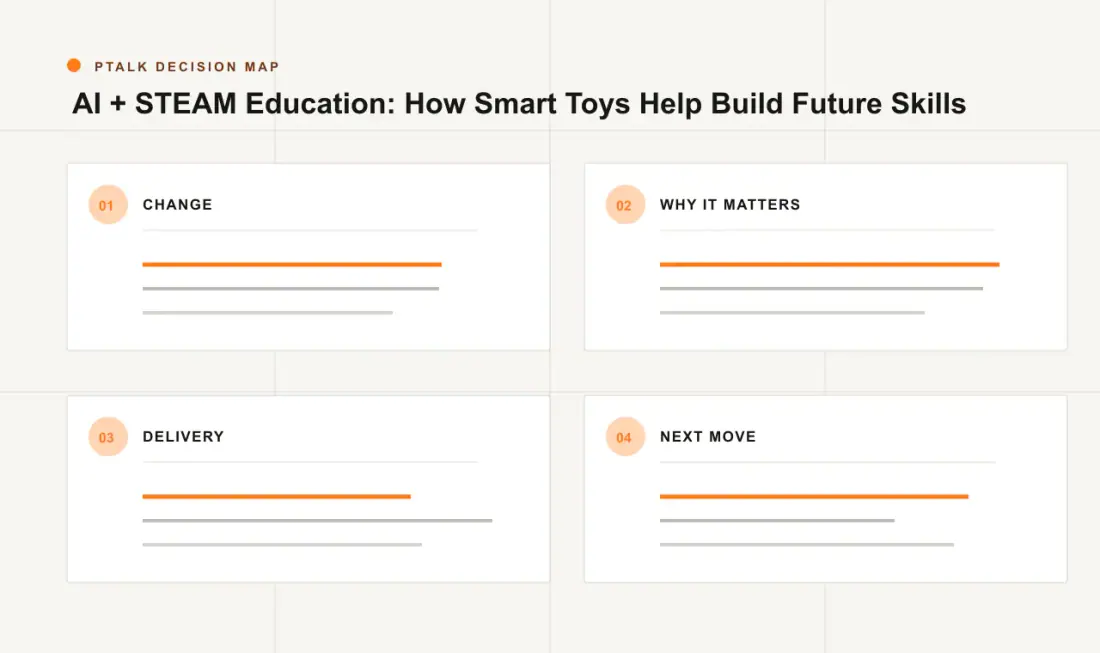
Read the decision in one minute, then use the full article for the details and boundaries.
AI-enabled toys can turn STEAM concepts into physical, conversational activities—provided the product connects age-appropriate content, feedback, hardware, and safe long-term operations.
The practical takeaway
AI-enabled toys can turn STEAM concepts into physical, conversational activities—provided the product connects age-appropriate content, feedback, hardware, and safe long-term operations.
Useful for teams studying AI toy product definition, hardware prototyping, agent platform setup, content safety, and production delivery.
For the AI toy decisions covered in this company news, PTALK can support product definition, smart hardware prototyping, agent platform configuration, knowledge base and persona content setup, AI mascot IP and tourism-content co-creation, content safety boundary design, device management and delivery review.
Start with the target user, device form, content scope, budget range, and launch timing, then move into prototype validation, backend configuration, pilot production, and production review.
Public pages explain capabilities, scenarios, cooperation paths, and specific evidence-backed credential or intellectual-property records. Pricing, lead time, other certifications, medical, privacy, copyright, and customer-data claims need project-specific confirmation.
Product configuration, scope, schedule, price, certification, and delivery responsibilities are confirmed against the actual brief.
STEAM education needs interaction, not only screens
Children learn better when they can ask, build, test, and receive feedback. AI-enabled toys connect physical play with guided dialogue, allowing science, technology, engineering, arts, and math topics to become concrete activities.
Smart toys as project-based learning carriers
A toy can guide an experiment, explain a concept in simple language, adapt difficulty, and encourage children to continue. When paired with a content platform, brands can keep releasing new lessons and themed activities.
PTALK's role
PTALK supports AI persona configuration, knowledge-base content, voice interaction, hardware sampling, production delivery, and backend operations so education-oriented toy products can keep improving after launch.